THE SHEPHERD KING

THE SHEPHERD KING

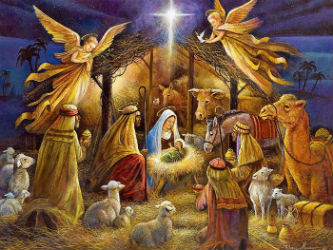
My wife, an artist, crafter, and master decorator, paints a different picture every season on the canvas that is our home. For that she draws on decades of crafts she has created and collected, all of which are important but none that rival her collection of crèches’, only thirty of which made the cut for this Christmas.

Few things say so much with so little as a manger scene, but I wonder, are we really listening? If we had to explain the scene to someone who had never heard the story, what would we tell? What is the meaning of that baby in the manger? Why is there a star on top? And what are those angels, shepherds, and wise men all about?

A phrase from Matthew’s version of the Christmas story stands out. It’s a combination of the messianic prophecy in Micah 5:2 and the fulfillment of God’s promise to provide a leader for Israel in 2 Samuel 5:2. “But you, Bethlehem, in the land of Judah, are by no means least among the rulers of Judah; for out of you will come a ruler who will be the shepherd of my people Israel.” (Matthew 2:6).

The phrase that lingers in the air, the one I think we miss at Christmas, is “ruler.” The star pointed the Magi to the one born “king of the Jews.” The shepherds went in haste to see the savior, who is “Christ the Lord.” The angels sang “glory to God in the highest …” Jesus is God, the ruler that would come. Jesus is the Shepherd King.

Kings are not the thing these days. There are only forty-three left in the world, and only eleven who have ruling authority.[1] Rulers make the rules and execute the laws of the land. They are supposed to govern, which means hold back the chaos so endemic to this fallen world. A ruler is one to whom obedience is owed. But we prefer to rule ourselves, and who can blame us? All earthly rulers suffer from the same sinful nature we inherited from Adam and we suffer with them.

But the babe in the manger is no mere earthly ruler. Jesus is the Shepherd King who lays down his life for his friends.

Let’s be real-world about this. What does that mean to a farmer who can’t get his beans out of the field because of the rain? To a sister whose brother hates and despises all she calls good? To a childless couple longing for a family? To the parents of a drug addict? To the children of an adulterer who walked out on his vows? To the man with same-sex attraction who wishes it wasn’t so? To high school teachers who get cussed every day and never see discipline applied? To a small business man working 60-70 hours a week to feed and clothe and educate a growing family? What does it mean in a world, as Jordan Peterson likes to remind us, where chaos is the norm and shalom is rare indeed?

It means many things, among them that chaos will one day come to an end and peace will reign. It means that all who have disobeyed and refused to repent will be punished and that those who have sacrificed for the King in his absence will be rewarded. It means that those who longed for the love of a family will inherit the family of God.  That now, even though we cannot see him, we have a shepherd who cares for us, a law that governs us, principles that guide us, his church to encourage us, and his Spirit to empower us through the chaos until the Kingdom comes. It means that we can afford to give ourselves away in love for others, including our enemies, as he gave himself on our behalf knowing that what we do in his name will be remembered by the King when he comes again to rule.

In the unlikely story, with all Herod’s might arrayed against him, of the birth and survival of the baby Jesus we also have the knowledge that what God purposes will get done. No matter what outward appearances indicate, as long as we are aligning ourselves with him, we will share in the glory of the King’s successes and receive his affirmation when he returns.

All hail the Shepherd King who rules and reigns on high

And grace and peace to his faithful ones until the day draws nigh

When he shall come with trumpet blast to take his earthly throne

And bless the world with righteousness when chaos is undone.

[1] https://www.washingtonpost.com/news/worldviews/wp/2013/07/22/meet-the-worlds-other-25-royal-families/?noredirect=on&utm_term=.ae8d33c41cd9

ELUSIVE CHRISTMAS JOY

Joy, for many of us, is elusive at Christmas. Instead of mounting happiness as October fades and November cools, our moods fall like spent leaves, wind drifts of brown on grass no longer green.

Reasons for sadness pile up as the year runs out.

“Holiday sales” burnout plays a part. Holy awe, and the joy it builds, is dulled by crass commerce that begins before Halloween ends. Only in America, where glitz is king, can the latest Mercedes induce more wonder than the Word made flesh.

But that’s not all the sales and marketing do. They remind many of us of things we’d rather forget, visual cues of tragedies past. Loved ones lost as the holidays arrived, graveside services in the snow. Or simply beautiful seasons of life that have come and gone, and will never come again, as children grow and jobs carry us away.

Then there is the actual gathering of family members, long dispersed and often better off that way. Seasonal expectations of heightened happiness against the backdrop of broken promises and dreams create a special kind of emotional dissonance. It’s hard to sing NOEL when your heart is full of Lamentations.

It was to people like that that the angel announced “good news of great joy.” People just like you and me. “For all people,” this news was come, “peace on earth, good will toward men.”

Ponder those words.

Men have peace with God. More to the point, God has declared peace to men. The relationship broken in the Garden of God, the fellowship lost when our first parents were banished from the place of blessing (read “Joy”) has been restored–restored not by man returning to the Garden, by earning or breaking his way in, but by God leaving the Garden and coming into the world. Truly, those who walked in darkness have seen a great light.

And the good news is “for all people.” Not for some, but for all. Not for the elite, but for all. Not for the powerful, but for all. Not for the popular, the famous, or the merely well-liked, but for all. Not for the religiously pure or the morally righteous, but for all. Not for one race, or kind, or nation, but for all. Not for someone else, no, the good news is for me, and for you, and for all.

A great assumption lies behind the angels’ news: That our estrangement from God is worse by far than all of the stress, all of the loss, all of the tragedies, and burnout combined. Indeed it is, because that estrangement is the root of all other alienation. And the reconciliation made possible by the babe of Bethlehem, the first step of God again into the world, was the beginning of true hope, the well-spring of lasting joy.

This Christmas, don’t look for joy from a brightly wrapped package under a tree, in family, or parties, or songs. These are just the trimmings. Look for joy in the face of Jesus. He has come to reconcile all who will believe, and he will come again to restore all things.

SON OF THE MOST LOW

She’s going to break my fingers! But I can’t tell her to stop!

That debate ran through the back of my mind while the front tried, and failed, to help my dear young wife face the panic and pain of her first birth. She was holding the fingers of my left hand all in a bunch, sitting on the sofa of our little apartment, and squeezing the daylights out of them with every contraction. We had already been to the hospital once and sent home. “She’s not ready. Come back tomorrow morning.” That had been hours ago. I thought she might pass out. Heck, I thought I might pass out. But the nerves, and the pain, and the anticipation kept us up all night. By the time the doc decided on a C-section, she’d been in labor seventy-two hours, but that’s another story.

I think about that when I think about Mary, Joseph, and Jesus. Like many of our contemporaries, we were having our first baby in a brand-new birthing center, with all the latest science, and comforts at our disposal, supervised by an obstetrician with decades of experience. Of course first century mothers had none of that, but Mary had reasons to expect better than she was getting.

Remember what the angel had told her? “Do not be afraid, Mary, you have found favor with God. You will be with child and give birth to a son, and you are to give him the name Jesus. He will be great and will be called the Son of the Most High. The Lord God will give him the throne of his father David, and he will reign over the house of Jacob forever; his kingdom will never end.”

With that kind of information about the child in her womb, it would be understandable for Mary to have high expectations. What kind of birth arrangements would God engineer for His Son? How would the Son of the Most High make his entrance?

But the birth of Jesus was a true worst case scenario for Mary and Joseph.

It came at the most difficult of times. The census had the whole country in upheaval. Roads were jammed with travelers; the price of 90-octane donkey fuel went through the roof. Tempers were short and lines were long. Everybody was stressed to the max and they had no choice about making the trip. Their son’s first day on earth would be a day marked by an act of oppression. He was born with a Roman boot on his neck.

It came at the end of a draining day. The distance from Nazareth to Bethlehem is only sixty miles as the crow flies. Maybe two hours by car. But it was a three-day journey for them–Joseph on foot, Mary at full term on a swaying donkey’s back, camping out under the stars, eating sparse meals. Even if Mary was a teenager, she was no doubt extremely tired and sore. They probably traveled alone as well, because by now it was known that Mary’s condition was not a result of her marriage to Joseph. Both must have felt a sense of isolation. There would be no joyous family celebration like the one at John the Baptist’s birth.

Finally, the baby came in the most desperate of circumstances. Joseph was still searching for a room when Mary’s labor pains began. The inns in Bethlehem were full of other census pilgrims who had traveled faster than an expecting mother could manage. As a last resort they took shelter in a stable, filled with the pungent smells of pack animals. The first air that would fill the nostrils of the Son of God was the air that peasants breathe.

I wonder what Mary must have thought of all this as she remembered the Angel’s words, “He will be great and will be called the Son of the Most High.” I know what I think. The Son of the Most High came to Earth as the “son of the most low.” God engineered the birth of His Son so that all who believe, from the lowest to the highest, could come to Him without fear, and experience the best gift He has for man, a life giving relationship with Himself.