In 2003, my daughters had a funny lesson on the inevitability of change. Their uncle Mike had given them a whole box of VHS tapes containing 144 episodes of Star Trek the Next Generation. The videos dated back into the 1980’s so watching them was like being in a time machine for commercials. But what really tickled the funny bone was seeing an ad for a brand new 1989 Chevy truck on Tuesday night, and then standing at the bus stop Wednesday morning, watching that same truck with 14 years and 175,000 miles on it go by. “It’s a heap!” They cried. Talk about a lesson on change!
Change is inevitable. It’s how we meet it that matters. The one luxury we cannot afford is to assume it will not touch us and refuse to prepare for it.
The nature of the human animal is to be dominant and territorial. We like to set ourselves up in a good situation and stay there. We work hard at creating stability and predictability so that we can enjoy life with the least amount of hassle. We are control oriented. Unexpected change reveals our lack of control and makes us feel naked in the cosmos.
The Bible is full of examples of God’s people meeting unexpected change. Consider Moses’ successor, Joshua, and the changes he witnessed: Slavery in Egypt, miraculous escape across the Red Sea, the Ten Commandments, the wandering in the wilderness.
For 40 years Joshua witnessed change, but that paled in comparison to what he was about to do. He was about to lead the people of God into the Promised Land itself. He was facing the walls of Jericho and he was doing it without Moses.
God had two commands for Joshua as he took up the challenge of this change, commands that still apply today.
Be strong and courageous.
In the decade leading up to 9/11 the notion was spreading that the days of strong, forthright leadership operating from the courage of conviction were passé. The world – it was assumed – was becoming a kinder, gentler place and there was just no need for confrontation when therapy or diplomacy could do the job. This was just as true in the church as it was in geo-politics.
The Bible is much more realistic than that. It teaches us that evil and danger, deceit and treachery will be in the world until Christ returns. The only way to meet those things is with strength and courage.
Those manage change well who have the courage of their convictions. But what convictions?
Stick to fundamental principles.
Strength and courage are dangerous if they aren’t harnessed to core principles that honor God and respect people. But strength and courage in the service of those principles enable us to adjust our approach to meet the need at hand.
Thomas J. Watson Jr., founder and CEO of IBM from 1956 to 1971 wrote, “I firmly believe that any organization, in order to survive and achieve success, must have a sound set of beliefs on which it premises all its policies and actions. Next, I believe that the most important single factor in corporate success is faithful adherence to those beliefs. And, finally, I believe [the organization] must be willing to change everything about itself except those.”[1]
Those manage change best whose principles are changeless.
Fear is the biggest hindrance to change. Change forces us to think, to adjust, to adapt. We prefer cruise control. When contemporary music first began to make its way in to worship many congregations rejected it. But that indicated more faith in the method than in the message. When new translations of the Bible began to compete with the KJV many churches rejected them. But that indicated more faith in the translation than the message.
As Chuck Swindoll wrote, “Extraordinary times will require of us extraordinary wisdom, vision, boldness, flexibility, dedication, willingness to adapt, and a renewed commitment to biblical principles that never change.”[2]
When the changes come—and come they will—go back to core principles and with strength, courage and wisdom apply them.
When change comes ask yourself: Am I operating with courage on core principles?
7 Only be strong and very courageous, being careful to do according to all the law that Moses my servant commanded you. Do not turn from it to the right hand or to the left, that you may have good success wherever you go.[3]
[1]Citation: Thomas J. Watson, Jr., A Business and Its Beliefs (1963); Bill White, Paramount, CA
The news of men has not been good of late. My friend Tommy died last week. The last I heard he was in the Roanoke Rescue Mission. But in the end, he was homeless, doing crack, meth, and heroin. The drugs took him at 52.
There’s the porn epidemic. As Catholic writer, Benjamin Wiker, has said, “Our sexual environment is about as polluted as China’s air, and the harm caused by such pollution is just as scientifically demonstrable.”[1]
Then there’s the swelling cohort of insecure, indecisive, incompetent young men whose directionless energies are squandered in endless pursuits of, well, that’s just it, nothing special. As Auguste Meyrat recently wrote, they are “hapless chumps” who can “make observations, crack jokes, ask questions…but they cannot make theses and support them.” Women may “friend-zone” these guys, but they won’t marry and have children with them.[2]
And its common knowledge that one of the greatest common denominators for mass shooters (not counting jihadis) is that they are young, alienated men, with absent, abusive, or just irrelevant fathers.
Males are born, but men are formed. And our culture is failing to form them.
Cultural trends for the last forty years mitigate against it. “A woman needs a man like a fish needs a bicycle,” founding feminist Gloria Steinem said, and a whole generation of women believed her and did without. That movement, along with constant media mockery of men as sleazy sex addicts or buffoonish oafs, removed much of the motivation men had to become something other than overgrown boys.
Healthy masculinity, the kind that gets tough when the going gets rough and tender when it doesn’t, has also been undermined by hypocrites like Bill Cosby and pedophile priests. But they are only the most famous of a multitude of men who hide predatory natures behind a faith and family friendly mask.
What’s to be done? Specifically, what can the church do? The most important thing we can do is buy into my thesis: Men are formed, not born.
There are definite attributes and specific disciplines that separate the men from the boys that can be passed down from one generation to the next. They have nothing to do with physical or sexual prowess and everything to do with character formation. We can work out the details of how to do that later, but we must buy in first. We must believe that positive masculinity can and should be formed in young men by older men.
Too many fathers and too many church men assume that “boys will be boys” and just let them raise themselves or worse, “let their Momma do it.” That’s not meant as a slam on moms who sacrifice endlessly for their children. But the truth is that young men do not respond the same way to women as they do men they respect. As a result, we have a generation of “feral children,” who—wishing they were real men—have mistaken real masculinity with owning powerful weapons and hyped-up pick-up trucks. Or else mistaken it for feminine virtues that, while admirable, aren’t masculine and therefore do not satisfy the innate need of a male to achieve manhood among other men.
My friend Tommy grew up a feral child. His father abandoned him early in life and rarely offered anything other than criticism for his son’s failings. Like all of us, Tommy made choices for which he alone was responsible. He had multiple opportunities to turn his life around. But I can’t help wonder how his life might have turned out if the right set of men had taken him in and committed to train him how to be a man.
The Seven Year Itch, a 1955 Billy Wilder film with Marilyn Monroe and Tom Ewell, surfaced an idea that had burbled along for some time in pop culture. To wit: married couples experience a decline in satisfaction over the first four or five years and, by year seven, tensions have risen to the point that they either divorce or adapt to each other in new ways. Some social scientists pooh-pooh the notion, but others have documented the phenomenon.[1]
I’ve been in the people business a long time and I think they’re on to something that affects not just our marriages, but every aspect of life. Calling it the seven year enthusiasm curve or passion cycle may be more accurate. But knowing what it is and how to deal with it can definitely increase your quality of life, may help you make better job choices, and might even save your marriage.
The burnout cycle in a nutshell: First, initial enthusiasm about a new idea, person, job, or ministry. We find something or someone new and fall in love. Second, energetic commitment to it, we go all in. Third, sustained effort for two or three years, we work hard at the new thing or new love and enjoy it. Fourth, inevitable problems emerge and the new thing starts to feel old, the gears grind, effort required increases as enjoyment declines. We hang on a couple more years, wondering where the love went. Fifth–and this can happen anywhere between years five and seven–the thrill is gone, burnout descends, and we start looking for something new to relight the fires of passion, or else begin casting blame for our unhappiness.
The end of the cycle can get ugly in all kinds of ways. People have affairs, start fights in churches, or jump from job to job, seeking long-term satisfaction at the price of instability and upheaval. (I first learned about this cycle not from the movies, but from a theology professor who had observed the dynamic in some of the more emotion-based expressions of Christianity).
But even if it doesn’t deteriorate into shouting matches, unconscious acquiescence is not the path to peace and happiness. So how do we beat burnout? A few suggestions:
First, plan to bail before you fail. Some things do not require life-long commitment and work better if we plan to step aside at a predetermined time. I did this as a soccer coach. When my kids were done, so was I. Ministry tasks, volunteer roles, hobbies, these and many more, benefit when we recognize the limits of our humanity and plan to move on to new things before passion becomes drudgery.
Second, identify your non-negotiable’s and plan to replenish your energy. Think of marriage. Think of calling, be it ministry, law, medicine, or business. If it is something worth keeping, it is worth the effort to build emotional and spiritual recovery and renewal space into your life to sustain it. God’s gift of Sabbath is part of this, as was the year of Jubilee for Israel, each occurring not so coincidentally every seventh day and seventh year respectively.
Third, develop long-term goals and short-term objectives that move you toward the goal, and then take time off to celebrate when each objective is met. Celebration replenishes energy.
Finally, and most importantly, build your life and learn to draw your strength, day by day and year by year, on the only one with an infinite supply of energy and passion: Jesus Christ, the same yesterday, today, and forever.[2]
One day a farmer, who was a Quaker, was having trouble with his mule. He was trying to plow his field, and the mule was being unusually stubborn. He wouldn’t move. So, the Quaker decided to talk to him ‘reasonably’. “Thou knowest that I am a Quaker. Thou knowest that I canst not curse thee. Thou knowest that I canst not whip thee. What thou dost not know is that I can sell thee to my neighbor down the road. He is no Quaker, and he can beat the living daylights out of thee.”[1]
All of us can identify with that Quaker. We face opposition. There are things we would like to say or do. Then there are things that we can do and still call ourselves Christians.
Nehemiah chapters four thru six are a study in how to deal with opposition. The first six verses of chapter four teach us three things about handling that antagonism.
Antagonism often manifests as ridicule. All of us are vulnerable to it because all of us have glaring weaknesses. Shine the light on them and we get discouraged. Nehemiah’s enemies pointed to five: their competence, their faith, their hope, their resources, and their potential.
All of us feel incompetent at some time or other. Never more than when we’re about to try something new. And we fear the name “fanatic” because it isolates us from our peers. Every task feels bigger when our hope is undermined. We’re easily intimidated when our resources are thin. And our confidence is shaky when we the risks of failure are high.
What to do when we face that kind of antagonism?
Let me give you an encouraging thought here. When someone is ridiculing your work it probably means that they are afraid you might succeed. The best thing that you can do then is…succeed!
Notice Nehemiah’s threefold reaction.
He Does Not Respond in Kind
We can waste a lot of energy trying to right every wrong that is spoken of us. Or we can take the same energy and invest it in doing good work and let the work speak for itself. Keep reminding yourself that people ridicule you because they are afraid of your success.
He Prays
And what a prayer! “Hear, O our God, for we are despised. Turn back their taunt on their own heads and give them up to be plundered in a land where they are captives.”[2] But what a problem for Christians! Aren’t we supposed to pray for our enemies, offer blessings instead of curses? Yes. But we live with two realities that Nehemiah did not have: The death of Christ and the life to come.[3] We know that we too are sinners, capable of injustice and slander. And we know for certain, because Jesus promise was validated by his resurrection, that all injustices will be made right by God in the end. So it is not wrong to pray for justice as long as we leave its execution to God.
The final thing Nehemiah did is the most powerful thing anyone can do in the face of ridicule.
He Got on With It
On September 18,1939 the British radio public began hearing a steady stream of ridicule from Lord Haw Haw. He was actually William Joyce, an American born Irishman who as a senior member of the British Union of Fascists, had escaped to Germany before he could be jailed. Every evening Joyce, broadcasting from Hamburg with the voice of an upper-class Englishman, ridiculed Great Britain’s losses to Germany, her lack of preparation, her hopeless situation before Germany’s superior military might. Many British subjects fell under his spell. But most did not. Most believed and followed Churchill.
Lord Haw Haw kept right on broadcasting until April 30, 1945, when British soldiers overran Hamburg.
The British did what Nehemiah and the Israelites did. They ignored the ridicule, went to work, and finished the job.
You know what happened to the Nazis. And William Joyce? They hanged him for treason on January 3, 1946.[4]
What to do in the face of ridicule?
Do not return evil for evil
Pray, allowing God to sort through your emotions and guide your convictions.
Ignore their words and do your work – perseverance pays dividends in the end.
[1] Boice, James Montgomery; Commentary on Nehemiah, pg. 50
Pivotal moments often arrive when we least expect them. An email in the inbox, a phone call in the evening and life reaches a cross-road. A new path emerges. Will we take it? Nothing will ever be the same if we do. And nothing will ever be the same if we don’t. We want to know, need to know, is it the right one? Is God in this? How can we tell? How do we know it’s him?
A man named Nathanael had a day like that. His story is in John 1:43 – 51, a text that always intrigues. Why did Nathanael react so profoundly to Jesus’ simple statement in verse 47-48? Why, when Jesus said, “I saw you under the fig tree …” did Nathanael make a pivotal declaration that would change his life forever?
“You are the Son of God! You are the King of Israel!” (v. 49).
Most commentators focus on verse 51, linking it to Jacob’s ladder in Genesis 28, and of course they are right. But that still doesn’t answer the question. Verse 51 came after verse 49. So, what happened? How did Nathanael know it was Him?
The first clue is in verse 48.
“How do you know me?” he asked. This, in response to Jesus’ comment, “Behold! An Israelite in whom is no guile!” tells us that when Jesus made that observation, he pinged something deep in the man. He revealed that he knew something about Nathanael that only God could know because Nathanael had only discussed it with God.
The fig tree is the clincher. Up until that point Nathanael could speculate that Jesus was a perceptive observer of human nature. But the fig tree in Jewish life is a literal place with a figurative meaning. A man sitting quietly under his fig tree is a man sitting in a peaceful place meditating and sharing his innermost thoughts with his creator. We might compare it to our favorite chair or place of prayer when we think quiet thoughts with God.
Imagine the topic of Nathanael’s meditation that day. What could it have been to draw such a powerful response? Something along these lines perhaps: “God I will not hide my thoughts. Nothing is hidden from you anyway. You know my going out and my coming in. I will tell you what I think and ask you my questions. Teach me your way.”
Imagine then that Nathanael goes on to speak to God about his struggles. It could be some sin or temptation. It could be unbelief or concerns about his people. It could be issues with his wife or his family or his work. We don’t need to know the specifics to identify with his struggle. We only need to know that he was being transparent with God in that moment under his fig tree. He was telling God what he really thought, even though it might not have been something he would want to say out loud at church. “God, I’m telling you the real deal here. I’m not holding anything back, not pretending to be holy. I’m just telling you the truth about what’s happening in my soul.”
I bet you’ve had discussions like that with God. I know I have. Then you open the Bible and it speaks to you in a way it never has before, or a song comes on the Christian radio station, or a man or woman of God delivers a word that pings your soul and you know without doubt that God saw you under your own fig tree. You know without doubt that your pivotal moment has come. You will confess that he is “the Christ, the Son of the living God,” or you will not. Either way, you know it was Him and you know life will never be the same.
When that moment comes, don’t be afraid. Take the turn. Follow him. He knows you better than you know yourself and he will take you to places you never dreamed you could go.
You’ve no doubt seen it, the Gillette ad titled: “We Believe: The Best Men Can Be.” Obviously, the shaving supplier’s marketing gurus hit a nerve. It had twenty-five million hits on You Tube and forty million on Twitter. But they may have also punched a hole in the bottom of the brand. Forbes reports, “reaction to the ad has been overwhelmingly negative, with comments on its YouTube channel running negative by an astonishing ten to one margin.”[1]
That’s not to say that everything Gillette was selling is wrong. Men and boys are having a tough time and need better role models. They are falling behind in education, are twice as likely to be diagnosed ADHD, commit most sex-crimes, refuse to get help when depressed, are more likely to commit suicide or end up in prison for murder. But the Gillette ad, and the American Psychological Association’s recently released guidelines for working with men and boys which preaches the same message, toe the gender-fluidity line of LGBTQ activist ideology. As John Stonestreet says in a recent Breakpoint, “the solution isn’t to caricature and then reject masculinity like a disorder. It is to re-discover and embrace real masculinity, which God declared to be “very good.”[2]
Stu Weber, in his excellent book, Tender Warrior, teaches that real masculinity can be broken down into four roles a man should play in all his spheres of influence: King, Warrior, Mentor, and Friend. “To the degree (these functions) are balanced the image is clear, and the man and those around him flourish. To the degree they are abased and abused, the image is distorted, the man withers, and those around him experience pain.”[3]
Of the four roles, King is the one least understood by men and most disrespected by pop-culture. The film, Black Panther, gives it a pretty good nod, but the authority and leadership inherent in the role are increasingly suspect. The best way to regain that respect is to properly fulfill the role.
Toxic masculinity abuses authority. True leaders exercise authority under authority. People were amazed at Jesus’s teaching because he taught as one who had authority (Matt. 7:29). But Jesus recognized that His authority was under authority. “I did not speak of my own accord, but the Father who sent me commanded me what to say and how to say it.” (John 12:49).
Toxic masculinity serves only itself. Weber explains that a King is a Pro-Visionary, a man who looks far into the future to plan and provide for those he serves. Like the biblical men of Issachar, he studies and understands the times and how to navigate them successfully. And like the biblical kings of old, he does this in multiple spheres: his immediate family, his church, his community, and his country.
Toxic masculinity abdicates the shepherding role. But a King provides order, mercy, and justice, creating an environment where life can thrive in a disordered world. With dignity and restraint, he holds himself, his family, his church, his community, and his country to the high ethical standards revealed in scripture. When it’s time to execute justice, he is a velvet covered brick. Men who do this won’t always be popular in the short run, but the people they serve will experience shalom.
A man doesn’t have to own a country to be a king. He just has to play the role and the kingdom will come to him.
The details are vague now, so many decades hence. He sat on a curb or was it a granite ledge? outside the downtown clinic. Either way it was cold, barren, like his heart. The girl—yes, still a girl only 17—was inside, had disappeared into the sterile glass door of the nondescript building. She had found the place, or had he? He couldn’t remember. Either way, it hadn’t been there long, a new edition to the healthcare—cruelest euphemism—landscape. But he had found the money. Oh yes, that he clearly recalled. He found the two hundred dollars it took to end the life in her womb. In blind, self-centered cowardice he thought he was solving a problem, keeping their secret. But the cold reality of what he’d done began unconsciously seeping into his soul that day like the humid chill coming through the concrete. He paid the doctor to kill his son.
How could he have done that? How could he not see? The evil was obscured in those days. “It’s just a blob of cells,” they said. But he should have known.
Little did he know in 1977 that he was only a grain of sand in the mammoth cultural landslide that was the sexual revolution. Free love never was victimless. Roe V. Wade, that revolution’s greatest victory, remains the longest bloodbath in history with the longest trail of traumatized survivors.
Time moved on and so did he until about a decade later, when his first child was born. Something clicked, a window opened inside, and he began to see. Life is precious! He should have taken the blow, not the girl. Not the child. He should have taken the guilt and shame with her and provided for them both. That’s when he started attending the annual pro-life march downtown on January 22nd. It was the least he could do, the only thing he knew to do besides giving to crisis pregnancy centers, to publicly repent and repudiate his past. To do something about the future.
It wasn’t enough. At least, it hasn’t been so far. The Pro-Choice propaganda political action machine continues to cover the selfish cowards—yes you men, I’m talking to you not the girls, not the women; you are the ones God holds responsible to protect the defenseless and provide for your children—among us. It did so again this week when forty-four Senators refused to back the Born-Alive Abortion Survivors Protection Act, the one that requires doctors and nurses to save the life of a baby who survives an abortion.
How could they? How could they be so blind? So selfish? So cold and hard? How can the doctors and the nurses, sworn to “first do no harm” stand aside and watch them die? They can no longer hide behind youthful ignorance or scientific uncertainty. They know. They KNOW what we are doing. They know the landslide has killed millions of innocents and yet they refuse to protect and defend.
In his forties a young man walked into his life. Energetic, intelligent, eager to serve alongside and be mentored. It took a while because he was so busy with family and work, but finally it clicked. Another window opened. “The timing is about right,” he thought. “This could be my son.” A strange wave of grief and gratitude washed over him. “God you are so good to me. I don’t deserve this privilege, but I accept it as a gift from your hand.” Many more surrogate “sons” have come and gone since, and slowly the wound has healed.
“Perhaps,” he wondered, “perhaps now, with the evil so blatant that they celebrate infanticide, this new generation of brave young men and women will finally have done with the death dance. Perhaps now, if enough of us will tell the truth of what we did and what it cost and how merciful God is—perhaps now they will ignore the propaganda, listen to the still small voice of conscience, and end this revolution for good.”
It’s February 13th and romance is in the air, or at least around the corner. Which leads me to ask this question: Do you know what the Bible teaches about romance and sex? Do your kids?
Most Evangelicals don’t and we’re suffering from it. We found out the hard way when our grown children, all three godly, intelligent young women, told us what a lousy job we did teaching them. Their verdict went something like this: “You did exactly what most Evangelical parents do with their children on this issue: freaked us out, scared us to death, and generally made us feel like sex is the last thing on earth we would ever want to have anything to do with, even in marriage. Other than that, you were great parents!”
When it came to sex, romance, and the Bible, we thought our daughters were fine. But like Mark Wahlberg said in The Italian Job, “you know what fine means? Freaked out, insecure, neurotic, and emotional.”
OK, they weren’t that bad, but it wasn’t acceptable either. That drove me to a Bible study on The Song of Songs. I benefited from Douglas Sean O’Donnell’s THE SONG OF SOLOMON: An Invitation to Intimacy, among others. Here are my top five lessons from Solomon on love, sex, and romance.
The Bible Celebrates Our Bodies
The Bible does not separate body from soul, matter from spirit, or godly purity from physical passion. It does not devalue the human body. It exalts it. Think of the incarnation! Think of the bodily resurrection! There is no belittling of sensual delights. Jesus turned the water into vintage wine! And he did it at a wedding! There is no contradiction between spirituality and sexuality, between loving God with heart, soul, mind, and strength and loving your spouse with your body. Enjoy it. It’s a gift from God.
Words Have Erotic Power
The Song is some of the most evocative and erotic poetry ever written, but none of it is coarse or crude. The lovers teach us to praise two things: physical beauty and character, and to be specific. Fill in the blanks about your lover’s body: Your eyes are … Your lips are … Your neck is … Your voice is …. Your skin is … Your fragrance is … Fill in the blanks about your lover’s character: Your mind is … Your personality is … Your heart is … Your skills are … The right words spark the fires of romance. The wrong ones snuff them out.
Timing is Everything
Lovers must make time for love, especially after children arrive. A man’s body works like a smoke detector: one whiff of the right perfume and he is on fire, all his bells and whistles blaring. Women’s bodies are like flowers at dawn, they wake up slowly in the sunlight of affectionate attention. Either way, wise lovers make time for love and don’t rush things.
Risk Heightens Eros
Risk plays a big role in romance. We love the risk-taking lovers: The young man who risks big bucks to follow his love to France, just to demonstrate his love; the teenager who put 500 sticky-note invitations to the prom on his girlfriend’s car; the guy who pays the skywriter big bucks to write “Will you marry me?” in the air above the football game as he kneels and holds out a ring. The extravagance and risk of failure or rejection communicates something powerful to the beloved: I WANT YOU MORE THAN MONEY, PRIDE OR SAFETY. I WOULD THROW MY LIFE AWAY TO HAVE YOU. Risk heightens Eros.
All the Roses Come with Thorns
East of Eden the “rhythm of married life is that of frustration and delight.”[1] There is a natural ebb and flow to romantic love, and the differences in our personalities and stress levels make it difficult to communicate. Be patient and forgiving with each other. The flower is no less sweet for the thorns.
As the book of Proverbs is good for all but addressed primarily to young men, so the Song of Songs is wisdom for all but addressed primarily to young women with their mothers as the primary teacher (8:2). Sing the Song for your daughters as they reach the right age and they will be far more than fine when they’re grown.
[1] David A. Hubbard, Ecclesiastes, Song of Solomon, The Communicator’s Commentary (Dallas: Word, 1991), p.313.
John is a grizzled grey, mid-fifties motorcyclist who thinks most people have their heads in the sand about disaster preparedness. “My friends laugh at me, think I’m crazy,” he said, “but I’m like, ‘Dude, you buy life insurance, right? You buy health insurance. Why wouldn’t you buy a little disaster insurance by setting a few things aside and being prepared?’”
John has a “bug-out ranch” a few miles outside town fully equipped with food, water, fuel, and guns.
I met John in Austin, Texas, on assignment for a journalism course last January. We were doing post-hurricane Harvey “man on the street” interviews to see how prepared people were for disaster. The answer was, and I include my fellow motorcyclist in this, not very well.
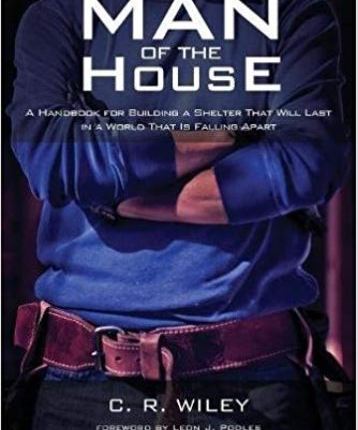
That’s part of the reason C. R. Wiley’s Man of the House: a handbook for building a shelter that will last in a world that is falling apart, caught my eye. Guys like John—also known as “preppers”—are realists about the potential disasters we face but are mostly thinking about themselves.
Wiley is not a prepper in the strict sense. He isn’t writing about how to stock your bug-out bunker with enough food and ammo to survive a sudden catastrophe but a long slow one. And not just for yourself, but for your children and grandchildren. “I am convinced,” he writes, “that the world as we know it is like a drunk that just won’t hit bottom. When things get bad, it sobers up a little and promises to change its ways—then when things get a little better it’s back to binge-drinking again. But there will come a day when we find the old boy comatose and gone for good. If we work at preparing for that day, we may find that we are more relieved than saddened by the end.”[1]
Man of the House picks up where the turn-of-the-century Christian men’s movement dropped the ball. Finally, someone has left “the elementary teachings about the Christ,” and gone on to maturity. Wiley assumes a basic understanding of the gospel and spiritual life and moves on to the practical matters of living out the faith in an increasingly unstable world. He unearths the ancient idea of the household, not as a place to eat dinner, watch a sitcom, and go to bed—a place from which we depart every day to work in the “real world”—but as it once was: a spiritual, social, economic, and political shelter that creates a world for generations of those who come under its roof.
Having given that endorsement I hasten to add that I disagreed with some of his ideas and found others not quite wrong, just over-torqued. Still, he is at least asking the right questions and offering thoughtful answers, a rarity in Christian men’s books.
Most guys don’t like to read, but this one is written to men for men. Wiley is a preacher, but unlike many of my kind he doesn’t waste words just because it comes easy (See? Those last five were superfluous. I can do this all day!). He uses what I call “man-speak.” Reading his book is like sitting around the table with Lewis and Clarke, planning their trip or a group of engineers and thinkers, planning to build a city. Serious men gathered for an interesting, challenging job, with enough humor thrown in to keep everybody’s egos in check. At twelve chapters and 135 pages it is also short. Each chapter takes about 15-20 minutes to read.
If you’re a young man trying to figure out how to navigate your family through this unstable world you would benefit from this book.
My teenage friends used to take bets on whether I was gay.
Perhaps you find yourself among the many young men of our day who wonder whether you might be gay. Conventional wisdom points you in that direction. Some things you are feeling and experiencing seem to confirm that hypothesis. But you are also experiencing a good deal of confusion and anxiety over it. I’m telling my story today to offer you a different paradigm, a different way to think about yourself, in hopes that it will encourage you to embrace the creature God designed you to be. I believe that in embracing that design you will find fulfillment and joy in your life and peace in your soul.
If you have no confusion, if you have no anxiety, and if you find the perspective I’m offering offensive, then you should probably stop reading here. But if you are wondering, please read on.
My teenage friends used to take bets on whether I was gay. The reasons seemed clear to them. I was not terribly aggressive or competitive. I enjoyed playing team sports, but I was never very good at it. For me it was more about camaraderie than competition. I was and continue to be, unlike most men, a very verbal, expressive, emotive, empathetic and relational type of fellow. I am comfortable expressing what I feel and talking about where those feelings come from. I am easily wounded by harshness, and hate. I avoid conflict, preferring to smooth things over rather than engage in confrontation. I have a high emotional IQ and operate, like many women, with a decidedly developed sense of intuition.
That, however, wasn’t all that my friends had in mind as they gambled over my orientation. Some of my earliest memories revolve around music and dance. I sang, tenor not bass, and acted in musicals and plays from elementary school through college. I LOVED the stage. My dream was to grow up and take over where Fred Astaire left off.
None of those traits seemed to fit the accepted masculine mold of the time which was and still is to some extent, athletic, competitive, emotionally reserved, and “concrete / rational” in perspective rather than intuitive. You may also have noticed that “real men,” (a dubious phrase if ever there was one) are good at math, engineering, construction and carpentry. They enjoy hunting, fishing pick-up trucks and hot rods. They don’t like to read, unless maybe it’s Field & Stream or Car & Driver, they never write, and they would rather do things than talk about what they feel any day of the week. Heck, many of them are so divorced from their emotions they don’t even know what they feel.
Finally, and this is by no means an exhaustive list, my friends were betting on some of my behaviors and associations. When I was in high school certain behaviors were considered indicative of homosexuality. They seem silly now, but I’m not making this up. Does he cross one leg over the other like a girl? Or hang an ankle on a knee like a guy? Does he like to wear colorful clothes that match? Or T-shirts and jeans? Does he file his nails with his fingers spread like a guy or curled toward him like a girl? All those things were considered indicators of gayness and I was guilty on all counts.
But perhaps most important were my buddies. One of my best friends in High School was one year ahead of me and struggling with his sexual identity. I didn’t know it at the time. I just knew that he was my friend. He helped me get my first job and gave me a ride to it before I could drive. When he and two other friends went to a six-week, college credit, summer drama school in Alabama I went along and hung out with him and the director of the play we were producing. The other guys hung out with the technical team leader and his crew. I was still unaware that my older friend and the director, a high-school music and drama teacher from Dothan, Alabama, were practicing homosexuals. I just knew that they would smoke pot and get drunk with me and I thought that was cool. They were my friends.
I had more gay friends over the following years although I was often unaware of their lifestyle. What I was aware of is that I had more in common with these friends than other men. I enjoyed their company because we enjoyed many of the same things, music, the arts, and reading etc. When, after high school, I finally learned of my friend’s secret life I was deeply upset by it and lashed out at him in anger. I couldn’t have explained then why I was so upset. But looking back on it thirty years later I realize that I felt a deep sense of betrayal, and not a little bit of fear. For reasons I’ll cover later I was a deeply insecure young man. If my good friend was gay, what did that really say about me?
If you are like me, you are probably wondering two things: Where did those similarities come from? How come you didn’t turn out to be gay? The answers lie in two words: Nature and nurture.
Nature covers much of it. If men are from Mars and women are from Venus, then I’m on some planet between the two whose orbit is closer to Venus. The encouraging thing I’ve discovered is that I’m not alone. Many men, more than you might imagine, share the traits I’ve outlined above, often attributed to women. And many women share traits more associated with men. My guess is the ratio is something like 30/70, or, three in ten women have personalities and gifting traditionally associated with men. Ditto for men with traits associated with women. That doesn’t make us gay. It does mean however that we will often feel out of the loop, disconnected from most of our sex. If we take our cues from the culture, which is increasingly pro-gay, we may conclude quite erroneously that we are gay too.
One other aspect of our nature plays a major part in this drama, the power of which cannot be overstated: sex. The chemicals released in the brain during sex: dopamine, norepinephrine, oxytocin, serotonin, and testosterone have a supercharging effect on human emotional and psychological bonding. We might say that we “imprint” on the other person – be they male or female, photographed or in the flesh – in the sex act. I call it crossing the shame/ecstasy threshold. Once we overcome our inhibitions (shame) and experience our first sexual act (ecstasy), even if we were coerced or manipulated into it as a child by an adult or other child, or even if it was acting out as part of the consumption of pornography, we are forever shaped by it. The supercharging power of the chemicals released will drive us to seek that experience again.
I was exposed to heterosexual pornography at a very early age. I followed a heterosexual path into adulthood. Had I been exposed to homosexual pornography at that age the outcome might have been very different.
Nurture covers the rest of it. Copious research indicates that children need healthy emotional connections with both of their parents. That connection includes three important elements: respect, identification, and affirmation. The child needs to respect both his mother and his father; identify with the parent of the same sex; and be affirmed in that identity by that parent. They gain their understanding of who they are and how they will get along in the world based on the models they see at home and the affirmation they receive. Failing a healthy connection with one parent, they will seek it in the other parent. By that I mean that sons who cannot connect with their fathers will get their emotional needs met and learn to orient themselves to their world through their mothers. It is possible for a mother to take her son too much into her world where, bit by bit, he loses his identity as a man. It is possible for a father to take his daughter too much into his world, where bit by bit, she loses her identity as a woman. Or a boy might identify more with his mother because she is a stronger personality than the father. Or a daughter might identify more with her father because her mother wilts under the father’s overbearing personality. There are many variations on this theme, but the bottom line is that the balance and harmony of male and female in the home is lost and the sexual identity of the child easily confused.
It is a father’s job to help his sons orient themselves and find their footing in the larger world. But like many of my homosexual friends I had a dysfunctional relationship with my father. My dad loved his sons. But it was difficult for him to express it. (It will come as no surprise that he did not have a good relationship with his dad either). I desperately wanted his approval, but it was difficult for him to give. (Dad said I was “pretty” and threatened to put a bow in my curly brown hair). My father also had a real problem with anger. He often lost his temper and occasionally beat my brothers and me far out of proportion to our offenses. This alienated us from him. Identification was lost. Still, I think those incidents could have been overcome had he been able to establish a healthy emotional bond with his sons. He was getting there when his life was cut short in an accident.
Why did that not lead me into the homosexual world when so many in my situation have gone that way? Teenage heterosexual experience, as mentioned above, is certainly part of it. A powerful, life altering encounter with Christ at age 20, where I submitted my will to his and promised to obey him no matter the cost was crucial as well. The rest I attribute to a specific answer to prayer.
I lost my Dad when I was sixteen. That loss launched me into a period of great emotional insecurity. Over the twenty years following God provided a series of healthy, responsible, godly, and mature men with whom I could identify and bond, who modeled healthy manhood for me, and who affirmed me. They gave me what I needed to become the man I am today.
If you’ve read this far then please stick with me a little while longer because I want to affirm you.
If you feel different from most of the boys and young men around you, if you seem to be attracted to other young men instead of young women if you are wondering what the matter with you might be, you are not alone, and you are not gay. Even if your first sexual experiences have been homosexual and you feel that powerful chemically based pull toward that life, you are not bound to it. You can be free. Jesus Christ can set you free and can give you the strength that you need to change. He can empower you to resist the urges that you feel and bring the chemicals raging within you back under control. He can reshape your mind so that you can begin to see his world and his creation from his point of view. He can help you become the man that you were meant to be.
I stand ready to help you. Other men in churches all over America will do the same. I urge you, to give your life to Christ and take the first steps to becoming the man you were made to be.






 dane skelton